Guaranteed Rugged
Longest Bolted Rock Climb in North America
June 11, 2022

There is a certain allure to doing the ‘biggest’ thing. Ascending the tallest mountain, climbing the hardest route, eating the most dumplings in a single sitting, there is a definite sense of accomplishment. Despite this, constantly chasing these feats doesn’t necessarily lead to the most satisfaction. One shouldn’t be overly concerned with the grade of a climb or the height of the mountain, but with how enjoyable the experience is. Fully aware of this, upon hearing about the phrase ‘longest bolted route in North America’, Caleb and I immediately dropped everything and made our way full speed towards this climb.
Guaranteed Rugged is certainly a long climb. Thirty-three pitches, it stretches upwards covering a distance of 1068m. The ambitious project, completed after two years of work, had just seen it’s first ascent in May so was a very new addition to the area. Located above Pavilion Lake in Marble Canyon, the climb takes its name from the slogan for the nearby town of Lillooet. Lying exactly 300 kilometer north of Vancouver, we weren’t sure whether to make our attempt a multi-day trip or try for one long day. The drive itself would take around four hours one way and the climb…who knew. It is graded at 10.d but only three of the pitches took on the grade. The majority were between 5.6 and 5.9 with a handful on either side. We planned to simul-climb easy pitches and link others. Based on previous experience, we really weren’t sure how quickly we would be able to climb. We would have to be extremely efficient if we wanted to ascend at any sort of reasonable pace. On top of this, the hike down would take a good two hours and we really didn’t want to do it in the dark.
Ultimately, we opted to try for one day. It wasn’t supposed to be cold so we decided that if we really needed to, we could bundle up in our puffy jackets and sleep at the top of the climb until it was light enough to descend. We’d bring an extra snack bar or two for our breakfast and dinner.

At 5:30 am we left Vancouver and sped through a quiet downtown and over an empty Lions Gate Bridge. Smooth sailing up the sea to sky, we were past Whistler in no time. Earlier in the year we had done some ice climbing near Duffey lake, and at the time that had been the farthest north in BC I had ever travelled. We were going further. As we drove north the landscape shifted and changed. Past Lillooet we left the coniferous forests and entered a vast and shallow glacial valley three kilometers wide. It was a large expanse, fields of yellow and green grass on top of ancient glacial silt flattened over many millennia into long plains of gentle slopes and wide fields. On either side of this flat expanse rose mountains now worn down, guiding the valley off into the horizon. The road wound its way through the fields dancing besides, above, and around a railroad track. Following the eastern side of the valley, the road would sometime rise above the wide valley floor revealing the sharp and jagged edge of a large and deep winding canyon cut sharply into the valley silt. The Fraser River flowed below but out of sight. It looked as if we had stepped into another world. Wooden farmhouses lay off in the distance among the vast sweeping landscape. It encapsulated, at least a bit, the notion of ‘the frontier’. Our road eventually curved off into a narrower glacial valley tributary to this valley and soon we were driving along Pavilion Lake. The tall rocky walls of Marble Canyon standing above us.

At 9:30 we park beside a road sign that said ‘Vancouver 300’. We gathered our gear then made for the start of the climb. We had to hike a good fifteen minutes uphill to the base of the rock and by the time we got there, I was breathing hard and feeling tired. Thirty-three pitches still to go. A little unsure about how we should proceed, we simply pitched out the first pitch: A shallow slab one could have walked up in approach shoes. In fact, this seemed to be a reoccurring theme. As we ascended and grew bolder with simul-climbing, we realized that most pitches could have been done in approach shoes. It would certainly have been a lot easier on the toes. We decided that any pitch under a 5.9 we could simul. With a list of the pitch grades on our phone, and the pitch number written besides each anchor, we knew what was coming so could adequately prepare. The climb rose higher and the rocks looser, but before we proceed, first a little interlude on simul-climbing.

Simul-climbing could, at least in some ways, be described as mutually assured destruction. If one climber falls, so does the other. This is due to the fact that both climbers are climbing at the same time whilst being attached together by a rope. This may initially sound like a bad idea. Simuling is really a method to increase efficiency and speed. Rather than having one person climb a pitch while the other person remains below to belay, then upon reaching the top of the pitch the second person climbs as the first person belays from above, both climbers ascend at the same time. One person above, and the other a certain length behind. This removes the time needed for belaying and greatly increases speed. As the first climber climbs, they place draws, and the second removes them. Once the first person runs out of draws, they stop at an anchor, belay the second up, and whoever wants to lead takes the quickdraws and begins to climb again. As you can see, with both climbers climbing at once, there is an increased risk of a fall, and if one falls, rather than a belayer catching them, they just pull the other off the wall. While the draws will catch you, it entirely depends on where your last draw was placed. Since you are typically climbing for speed on easier terrain, you likely didn’t clip all the bolts. So, especially for the person leading, it could potentially be a very unpleasant fall. Because of this the rule is: Don’t fall while simul-climbing.
And so, we simul-climbed when we could, going several pitches at a time. With a large portion of the climbing being on the verge of scrambling, we were going entire pitches without placing any draws. Perhaps we’d clip an anchor out of a feeing of obligation. While not the best practice, if we really did fall, we would have simply tumbled down a little bit and come to rest on one of the many flat sections. ‘Climb’ was pushing it in terms of definition.

Due to the type of rock and the fact that it hadn’t seen any traffic yet, the rock was loose and crumbly. We had to take great care not to kick down any debris. On several occasions the rock simply gave way under my foot, so we proceeded with caution. Far in front us we spotted two other groups. Fortunately, they were sufficiently far ahead that any rocks they kicked loose wouldn’t be headed our way. As we ascended the lower apron, which consisted of the first nineteen pitches, we climbed high above the lake below.
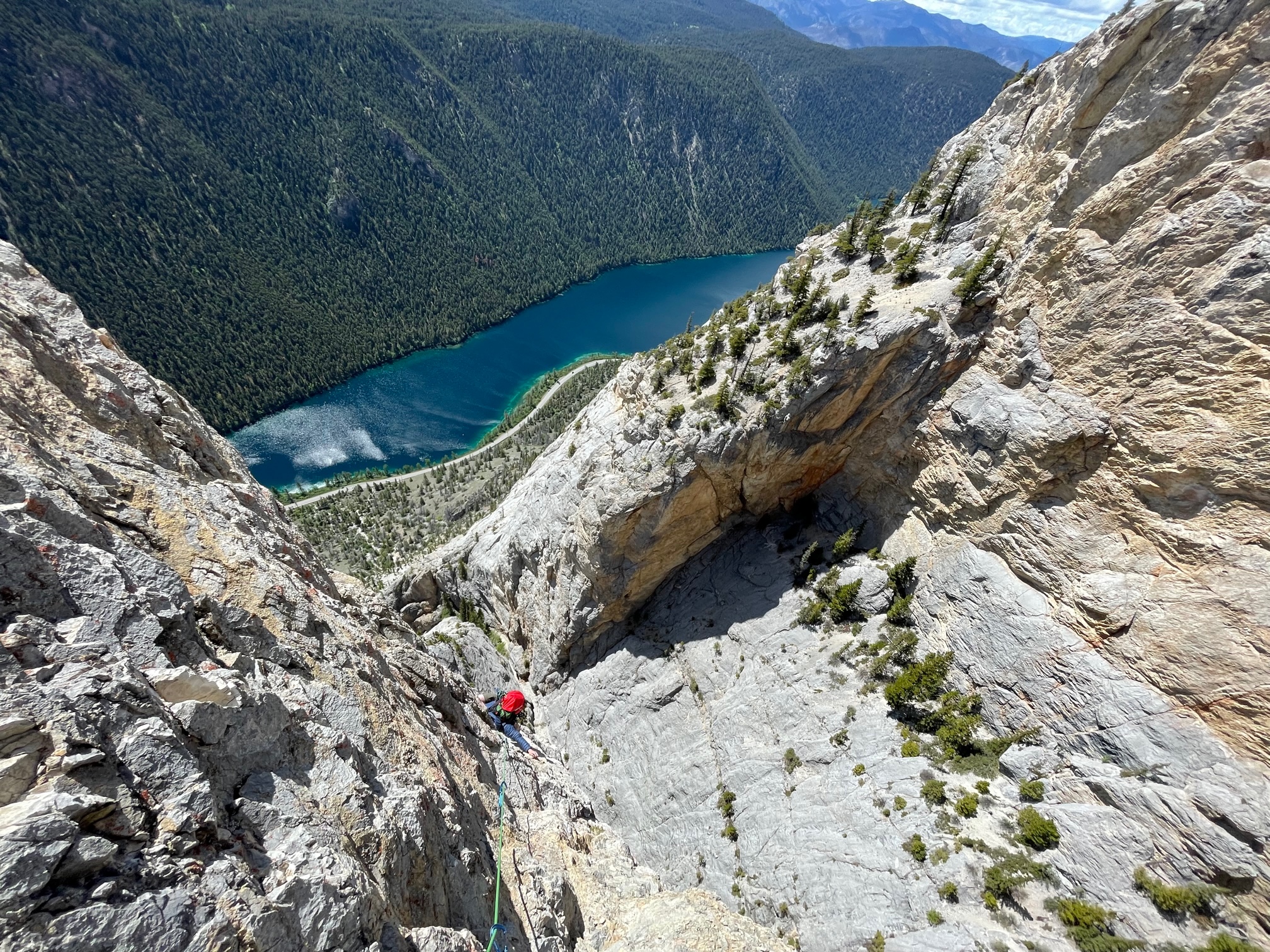
Hitting pitch 20, we reach the steep headwall. Grey limestone towered intimidatingly above us. The grades grew harder and pitch 22 became our first 10.d of the day. Leading up a steep slab, you step left around a corner into thin air. A sheer drop falling a long way. The exposure became intimidating but exhilarating. The next two pitches, also 10.d, wound their way up this steep face providing the best climbing by far of the whole thing. It was not a tough climb, not quite a 10.d, but what it lacked in technical requirement, it made up for in instability and crumbliness. Each hand and foot hold had to be tested thoroughly lest it break away sending you tumbling. Needless to say, for these sections we did not simul-climb. Once past these five or six pitches of the headwall, we reached the final summit ridge. More of an easy scramble than a climb, we barely concerned ourselves with climbing procedure as we stepped our way up, feet burning with the intense pain of being stuck in climbing shoes for six hours. Pitching the final 5.9, we made the summit and tore our shoes off. The valley stretched on below. The longest bolted route in North America complete.


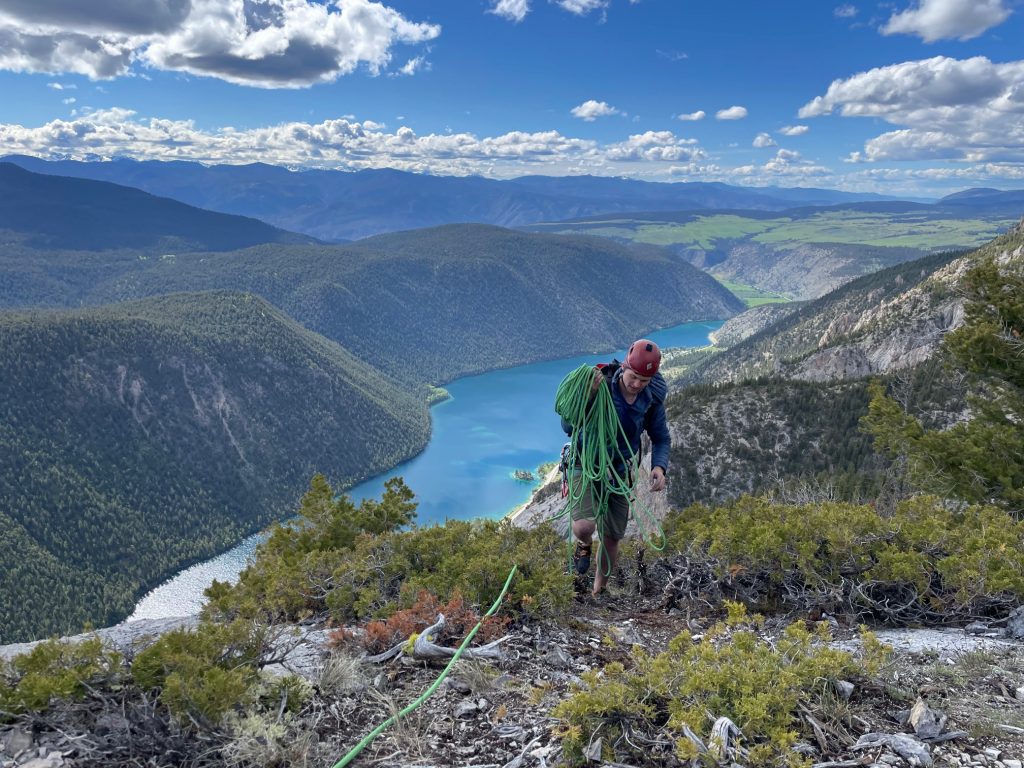

The climb was fun, and we had done it very quickly. We had caught up with the people in front of us who had just been distant specks when we started below. It was only four thirty so we had plenty of time to descend. We enjoyed a snack bar, which was the first food we had eaten since breakfast, and took in the beautiful views while resting our feet and fingers. Eventually, we set off again knowing that we had a long drive ahead of us, and the adventure wasn’t quite over. In fact we soon discovered that the hike down was the most treacherous part of the whole excursion. A steep untraveled trail followed a large gully downwards. Encountering every sort of terrain from soft mossy ground, to rotting vegetation, to fine dust, and to every sort of scree imaginable, we needed every ounce of our concentration to avoid slipping and tumbling down. After a long day of climbing, it was an exhausting surprise. We wished we could simply appear at the car having skipped any sort of down hike. After two hours, we were spit out onto the road near our car. It had taken a total of nine hours. Not too bad. It was my turn to drive so I took the wheel, and we were home before midnight.


It’s always amusing looking back at the adventures I have done. It sounds a little crazy that we drove six hundred kilometers, climbed for over six hours, and hiked for two…all on a pleasant Monday in June. I hope the day never comes when these last minute overambitious adventures stop.
Kynan, just came across this. You write well, I enjoyed it. Happy trails this summer, I’ll look forward to reading more of your TRs. Sean
Hi Sean, glad you enjoyed it! Can’t wait for rock season to begin, though I think I’ll try and get onto some glacier ice this summer. Kynan